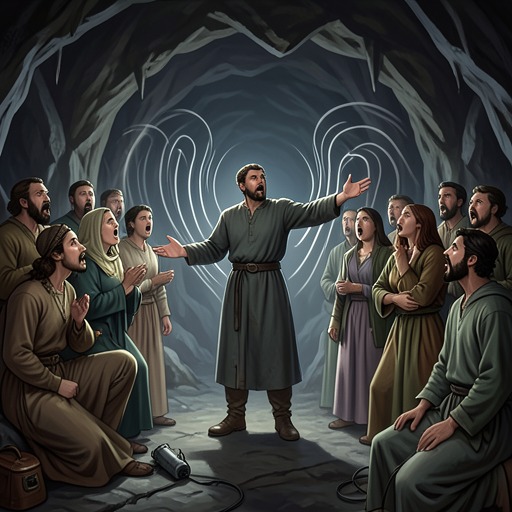
Eurydice
Metamorphoses (Ovid Edition)Eurydice is the deceased bride at the center of the story of Orpheus and Eurydice, where her brief return from the underworld becomes a second and final loss. Her character is defined less by extended speech than by the sequence of her death, restoration, and renewed descent: she is first taken from the living world by a venomous viper, then recalled among the shades through Orpheus’s love and song, and finally lost again when he looks back before they have escaped the underworld.
Identity and Introduction
Eurydice enters the narrative as a bride moving among the Naiads. The wedding setting is immediately darkened by inauspicious signs, and the danger becomes specific when a venomous viper bites her as she passes. She falls at once and dies suddenly, so her transition from bride to shade is abrupt rather than prepared by a prolonged illness or heroic struggle. The scene establishes her as the innocent victim of an external, unforeseen force and makes the wedding itself the threshold at which ordinary happiness collapses.
Her death also determines the emotional structure of the tale. Orpheus is not responding to a distant or abstract loss: he has lost his bride at the very beginning of their married life. Eurydice therefore represents a future interrupted before it can unfold, while the narrative's later rescue attempt turns mourning into an effort to reverse the boundary between life and death.
Death and Passage into the Underworld
The viper's bite is the decisive cause of Eurydice's first death. The text presents the event with compressed finality: she is bitten, falls, and breathes her last. That speed gives the episode its cruel disproportion. A wedding procession associated with communal joy is transformed into a funeral crisis, and Eurydice is carried from the company of the Naiads into the realm of the dead.
Her condition is not treated as an ordinary disappearance. She becomes part of the population of shades, subject to the authority of the king and queen of Hell. Yet the underworld is not entirely closed to her. When Orpheus's grief reaches the rulers of the dead, their pity allows an exceptional interruption of the normal order: Eurydice is summoned from a troop of newly arrived shades and stands revived. Her restoration is thus both miraculous and conditional, a return granted by supernatural compassion rather than a permanent conquest of death.
The Failed Return
Eurydice's revival offers the story's moment of apparent reversal. She advances slowly and haltingly toward the living world, while Orpheus leads her out under the condition that he must not look back. The condition places Eurydice in a peculiar position: she is physically restored, but her survival depends on another person's restraint. Her fate remains linked to Orpheus's conduct even after the underworld has released her.
As they approach escape, Eurydice's longing becomes visible. She casts impatient eyes backward to catch a final look from her lover, but that look is her last. The desire for reciprocal recognition collides with the rule governing her return. Orpheus turns, and Eurydice immediately descends again into the underworld while he reaches out toward empty air. The second death is especially devastating because it follows revival and because the lovers are already near reunion. The first loss is inflicted by the viper; the second is produced at the instant when love, anxiety, and backward-looking desire defeat the required discipline.
Eurydice dies again without reproaching Orpheus. Her silence gives the ending a distinctive tenderness. The narrative does not convert her into an accuser or make her condemn the act that separates them. Instead, she remains the figure being lost, while Orpheus is left with the knowledge that his attempt to recover her has made the separation final.
Relationships and Narrative Role
Eurydice's defining relationship is with Orpheus, whose grief supplies the force of the rescue attempt and whose failure determines its outcome. She is the beloved for whom he enters the underworld, confronts its rulers, and receives an unprecedented concession. Their relationship is therefore represented through action across the boundary of death: Orpheus pursues her beyond the living world, while Eurydice follows him back toward it.
The story also places Eurydice within a wider ritual and communal frame. She is introduced amid the Naiads, whose presence connects her death to the disruption of a bridal community. Later she is one shade among many, and her individual identity is momentarily recovered when she is called out from that collective of the dead. Her movement from bride, to shade, to revived woman, and back to shade traces a series of changed statuses rather than a simple disappearance.
Eurydice's function resembles that of the rescued beloved in a descent-and-return plot, but the pattern is deliberately inverted. The journey into the underworld succeeds only temporarily; the rescue becomes a test; and the return fails at the threshold. Her story consequently makes the boundary between life and death appear permeable, yet not controllable. Love can summon the dead, but it cannot abolish the conditions under which they are restored.
Change, Ending, and Significance
Eurydice undergoes three decisive states: living bride, dead shade, and briefly revived beloved before becoming a shade once more. The changes are not voluntary transformations but imposed passages governed by accident, supernatural judgment, and the consequences of a forbidden glance. Her final condition repeats the first loss while changing its meaning: she is no longer merely a victim of the viper, but the object of a failed return whose possibility has been cruelly demonstrated.
Her ending gives the narrative its tragic reversal and its strongest image of separation. Orpheus's arms extend toward empty air, while Eurydice descends beyond his reach. The lovers are divided not because love has weakened, but because love's impatient demand for confirmation interrupts the rule that could have reunited them. Eurydice's final, reproachless death turns her into the enduring image of an irrecoverable past: once the living look backward, the lost beloved belongs again to the dead.
In the larger pattern of metamorphic stories, Eurydice is notable because her transformation is primarily a change of state between worlds rather than a change into a plant, animal, or landscape. Her restoration and renewed death expose the limits of reversal itself. The narrative permits alteration, but not mastery: Eurydice may be recalled, yet the past cannot be made permanently present.